
Onboarding tips for locum tenens: My guide to hit the ground running

Amy Engelhardt • Follow
Calendar icon June 26, 2026 • 10 min • Share icon
Smiling healthcare professional wearing surgical scrubs, a scrub cap, and protective glasses in a clinical setting, representing onboarding for travel clinicians.

Highlights

  • Learn practical onboarding tips from a practicing locum CRNA, sharing how to start assignments smoothly and confidently.
  • Follow a real-world onboarding checklist that covers credentialing, first-day preparation and understanding facility expectations.
  • Avoid common locum onboarding mistakes by staying organized, confirming system access and asking the right questions early.
  • Understand how working with a reputable locum agency can streamline credentialing, logistics and communication so you can focus on patient care.

Eight years into my career as a Certified Registered Nurse Anesthetist (CRNA), I’ve spent the last five years working locum tenens assignments — easily one of the most rewarding chapters of my journey. What I’ve learned is that success in locums goes beyond strong clinical skills. It’s about preparation, understanding expectations and stepping confidently into new environments. Here are a few tips to help you start your next assignment on the right foot.
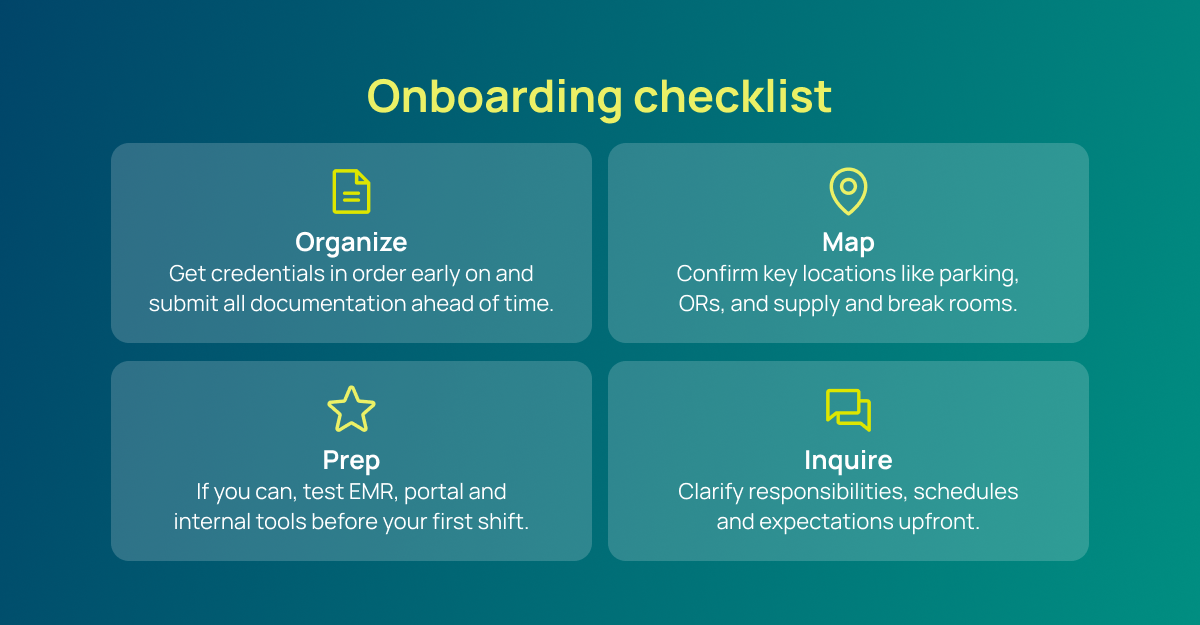
My locum tenens onboarding checklist

1. Get documentation done early

One of the biggest lessons I learned early on is to submit all credentialing documents well ahead of time. If you miss a medical staff credentialing deadline, you risk delaying your start date by weeks. Send everything promptly to avoid last-minute bottlenecks.

2. Prep before day one

Before ever stepping into a new facility, I try to:

      • Know where I should park and enter the building.
      • Confirm EMR login access and pharmacy credentials.
      • Save essential contact numbers and login info in one place on my phone for quick reference.

Strong pre-shift prep, for even the smallest details, can reduce first-day stressors and lets you focus on clinical work, rather than logistics.

3. Take advantage of site tours

If a site tour is available before or on your first day, take it! For me, knowing where key supply rooms, the PACU, ORs and even (let’s be honest) the coffee station are located gives me a huge confidence boost. Take advantage of any opportunities facilities offer that show you the lay of the land to help you acclimate faster.

4. Know the department expectations

Before the assignment starts, I always ask:

      • What is the daily workflow like?
      • How large is the team?
      • Are there specific policies I should review ahead of time?

Getting these answers ahead of time help me show up feeling prepared and ready to contribute so I’m not overwhelmed.

Create a career that offers real balance for your real life.

Explore locum opportunities now.

Embrace the team

Not all onboarding processes are perfect, but what has made the biggest difference for me is feeling welcomed by the staff. Find someone on the team who can be your go-to point person for small questions and don’t underestimate how much offering a friendly introduction eases the transition.

Onboarding checklist infographic with four steps: Organize, Map, Prep, and Inquire, outlining best practices for travel healthcare professionals before their first assignment.

How reputable agencies set you up for success

One of the biggest assets I’ve found in navigating locum tenens transitions is having strong support behind me — and that’s exactly what I’ve experienced with Aya Locums. From the moment I applied for my first assignment with them, the process felt manageable and transparent, which is absolutely critical when you’re tackling multiple new systems and workflows. With Aya Locums, I get:

Incredible recruiter support: I was paired with an amazing recruiter who has dialed in on my preferences, career goals and concerns. More on that below!

Documentation assistance: Their in-house teams work with me to collect documents, assist with state licensing and coordinate privileging and credentialing so I’m ready to go before my first shift.

Housing and travel logistics: They manage or reimburse housing and travel logistics, depending on the assignment, which removes a major layer of stress from onboarding and relocation.

What recruiters do — and why they’re so important

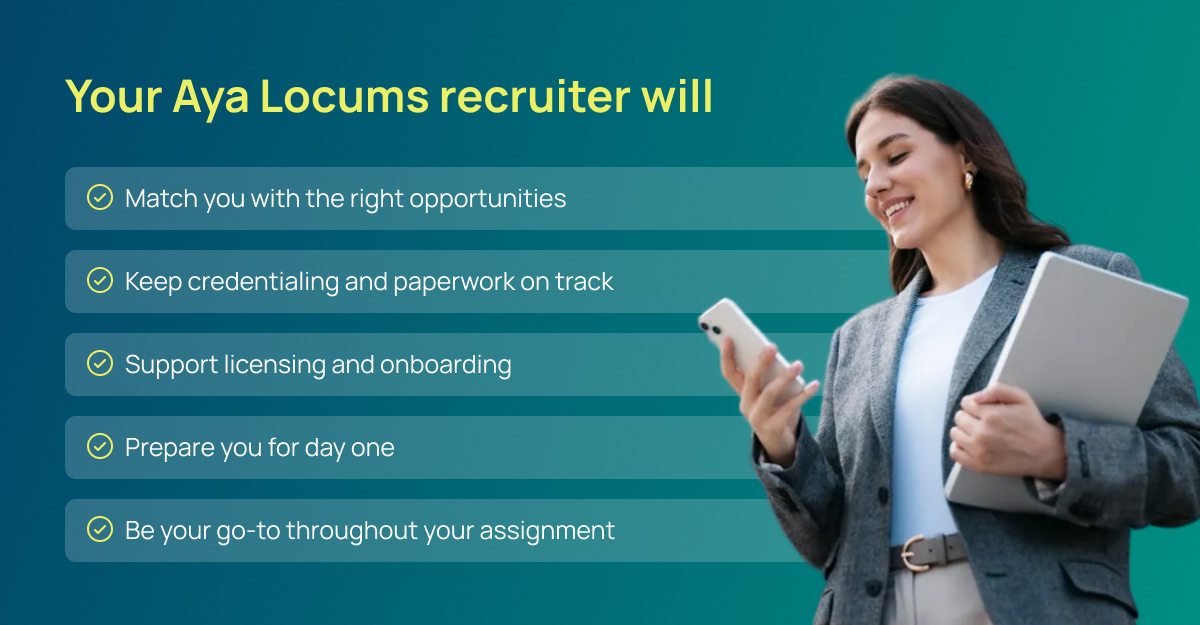
Good recruiters are worth their weight in gold. They not only keep you updated on your credentialing status, but also can help you prepare for interviews, navigate credentialing requirements and negotiate competitive pay. My Aya Locums recruiter stays in touch with me throughout my entire assignment. Ongoing communication makes a world of difference when I’m entering a new clinical environment, so I suggest staying in close contact with your recruiter. Never hesitate to ask them for clarity or assistance — they’re truly your advocate throughout onboarding and beyond.

My advice for new locum tenens

If you’re considering locum tenens for the first time, here are my top tips:

Plan smart and stay flexible.
I’ve heard too many stories of clinicians beginning preparation only to have dates shift because of a credentialing lag. So, I suggest waiting until your start date is confirmed before scheduling flights or housing.

Bring an open mind.
Every facility operates a little differently. Embrace learning the workflows and meeting new teams. Trust that you bring valuable skills wherever you go.

Preparation brings peace of mind

At the end of the day, smooth onboarding isn’t about perfection — it’s about preparation, communication and having the right support system in place. If you’re ready to explore locum tenens or want to elevate your current experience, I strongly encourage you to connect with a reputable agency like Aya Locums. Having a dedicated recruiter, streamlined credentialing support and help with travel and logistics allows you to focus on what matters most: providing excellent patient care. When onboarding is done right, you don’t just start strong — you set yourself up for long-term success in locum tenens.

Amy Engelhardt

With more than eight years of experience as a Certified Registered Nurse Anesthetist (CRNA), Amy Engelhardt has spent the past five years working locum tenens assignments across diverse clinical settings. Through her work, she has developed practical strategies for navigating credentialing, onboarding and adapting quickly to new teams and workflows. Amy is passionate about helping fellow clinicians feel confident and prepared as they explore locum tenens opportunities.

Learn more about Amy Engelhardt

All information, discussions and opinions contained within this blog or otherwise on the website or any linked materials (the “Blog Content”) is for general informational purposes only.  All Blog Content is based on the author’s opinions and experiences and is not necessarily representative of our opinions as an organization. It should not be considered as tax/financial advice, legal advice, compliance advice, health advice or other professional advice and does not constitute the practice of any medical, nursing or other professional healthcare advice, diagnosis or treatment or provision of legal services. You should seek professional assistance for any concerns or issues. If you or any other person has a medical concern, you should consult with your healthcare provider or seek other professional medical treatment immediately. While we strive to provide accurate and up-to-date information, we make no warranties or representations regarding the completeness, reliability, or accuracy of the Blog Content. Your use of the Blog Content is solely at your own risk and we will not be liable for any damages or losses arising from the use of, or reliance on, any Blog Content.